My path to organizing a roundtable on Medicine and AI was anything but direct. It took three decades, two U.S. patents, a detour through Tokyo finance, and one abandoned medical school application to arrive at what now seems obvious: the most important questions about AI in medicine are not technical questions at all.
A Family of Healers
I grew up in a medical family. My father was a physician, and the rhythms of clinical life — the late-night calls, the weight of diagnostic uncertainty, the covenant between doctor and patient — were the background music of my childhood. Medicine was the assumed destination. I studied electrical engineering and computer science at UC Berkeley not to escape medicine but to approach it from a different angle.
That angle kept widening.
The Long Way Around
After Berkeley, I spent time in Tokyo working in finance, then returned to the University of Texas at Austin for a master's in electrical and computer engineering with a focus on cognitive science. At the University of Iowa College of Medicine, I built one of the first web-based electronic patient record systems as an American Heart Association Research Fellow — close enough to clinical medicine to see both its power and its informational poverty. Patient data lived in silos. Clinical decisions were made with incomplete pictures. The problems were not medical. They were computational and, more fundamentally, human.
Then came Silicon Valley. I co-founded SafeWeb, an internet privacy company that ran the world's largest anonymous web proxy — 2.5 million page views per day, primarily serving users in countries with internet censorship. The CIA's venture arm, In-Q-Tel, made us one of their earliest security investments. We built SSL VPN technology, I became CEO, and Symantec acquired us for $26 million. I hold two U.S. patents from that work.
It was exhilarating and deeply unsatisfying. I had helped build tools that protected people's privacy and security, but the deeper questions — What should technology do? For whom? At what cost? — had no place in a product roadmap.
The Turn Toward AI and the Humanities
In 2016, Katherine Elkins and I co-founded what became the world's first interdisciplinary human-centered AI curriculum at Kenyon College. The premise was radical for a liberal arts college: teach every student — English majors, political scientists, art historians — to build, critique, and think ethically about AI systems. Not AI literacy. AI fluency.
The results surprised everyone, including us. Over 400 original student AI and machine learning projects. Female enrollment that grew from 18% to 61%. A dropout rate of zero. Students who had never written a line of code were building sentiment analysis pipelines, auditing large language models for bias, and presenting at academic conferences.
What made it work was not the technology. It was the collision of perspectives — a philosopher interrogating a loss function, a historian contextualizing training data, a pre-med student asking whether an algorithm's "fairness" matched any definition a patient would recognize.
Why Medicine and AI Needs the Helix Center
This is exactly what the Helix Center does, and why I was drawn to its executive committee. The Helix Center's roundtable format — small, interdisciplinary, no presentations, just conversation — is built for the kind of problem that Medicine and AI represents.
Consider what our five panelists bring:
- Tanzeem Choudhury builds mobile sensing systems for mental health and knows that the hardest problem is not the algorithm but the clinical handoff.
- Nadav Brandes develops protein language models that predict the effects of 450 million genetic variants — a scale that makes individual clinical interpretation impossible without AI.
- John Crary is a neuropathologist who has built AI tools for brain aging and neurodegeneration, working at the boundary where computational pattern recognition meets irreducible biological complexity.
- Rumi Chunara studies how algorithms encode and amplify health disparities — the equity dimension that most AI benchmarks ignore entirely.
- Yindalon Aphinyanaphongs has deployed over 30 operational AI models at NYU Langone, confronting the gap between research performance and clinical reality every day.
No single discipline can hold all of these perspectives simultaneously. Genomics, neuropathology, digital health, health equity, and clinical deployment speak different languages, use different evidence standards, and optimize for different outcomes. A roundtable is the only format honest enough to let these tensions surface without resolving them prematurely.
What I Carry to This Conversation
My work at NIST's AI Safety Institute Consortium — where I serve as co-principal investigator for the Modern Language Association's team — has taught me that AI safety in medicine is not primarily a technical problem. It is a problem of language, culture, and power. When we "red-team" a large language model, we are really asking: Whose values does this system encode? Whose experience does it erase?
My research on narrative and AI — SentimentArcs, the work on whether GPT-3 can pass a writer's Turing test — might seem far from medicine. But narrative is how patients make sense of illness, how physicians reason through differential diagnoses, and how societies decide which technologies to trust. The stories we tell about AI in medicine will shape its adoption as much as any clinical trial.
An Invitation to Think Across Boundaries
If my career has taught me anything, it is that the most consequential innovations happen at disciplinary boundaries — not despite the friction but because of it. An engineer who has worked in medicine, privacy, security, AI safety, and the humanities does not have a "diverse background." He has a single background that refuses to respect artificial boundaries between fields.
On April 18, I hope you will join us. Prepare with our study guide. Come with questions that cross boundaries. The conversation will be better for it.
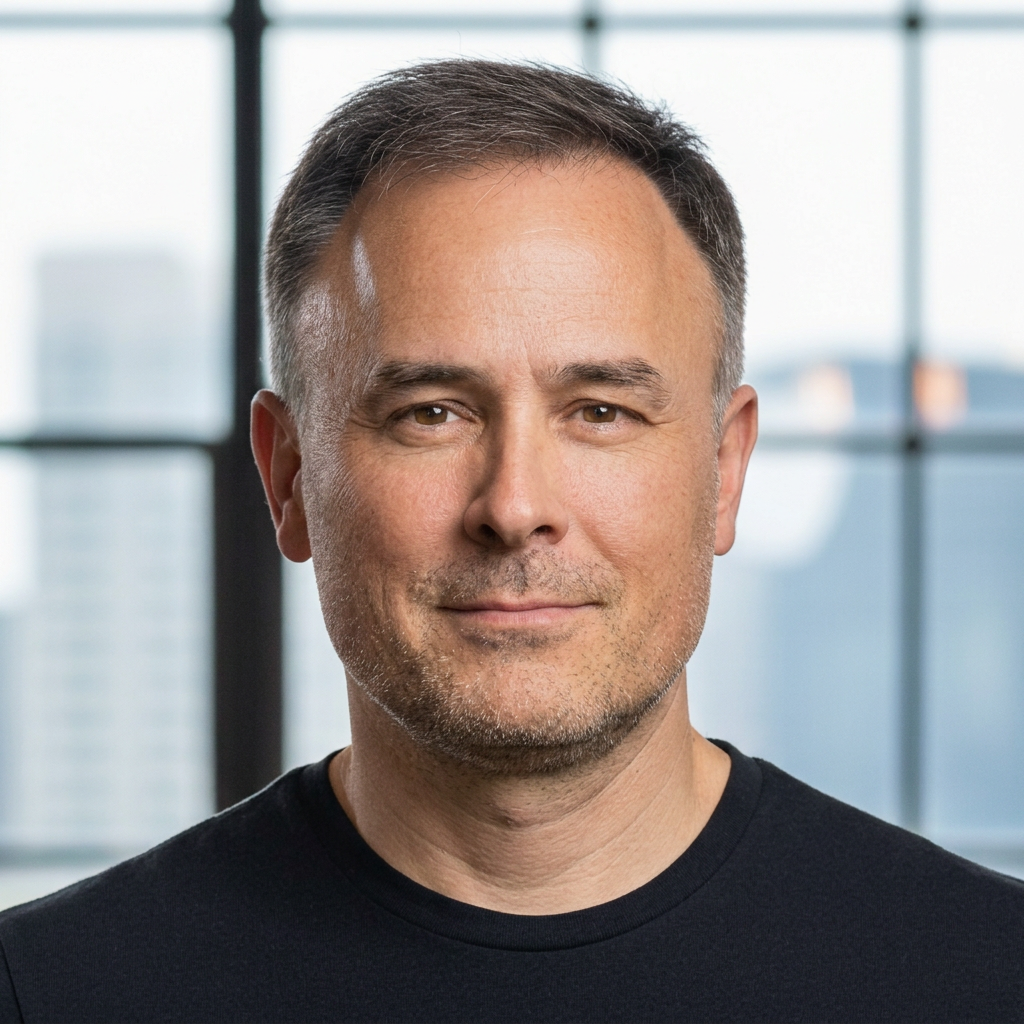
Jon Chun is a member of the executive committee of The Helix Center. He co-founded Human-Centered AI Lab and the human-centered AI curriculum at Kenyon College, and serves as co-principal investigator for the MLA's participation in the NIST AI Safety Institute Consortium.
My path to organizing a roundtable on Medicine and AI was anything but direct. It took three decades, two U.S. patents, a detour through Tokyo finance, and one abandoned medical school application to arrive at what now seems obvious: the most important questions about AI in medicine are not technical questions at all.
A Family of Healers
I grew up in a medical family. My father was a physician, and the rhythms of clinical life — the late-night calls, the weight of diagnostic uncertainty, the covenant between doctor and patient — were the background music of my childhood. Medicine was the assumed destination. I studied electrical engineering and computer science at UC Berkeley not to escape medicine but to approach it from a different angle.
That angle kept widening.
The Long Way Around
After Berkeley, I spent time in Tokyo working in finance, then returned to the University of Texas at Austin for a master's in electrical and computer engineering with a focus on cognitive science. At the University of Iowa College of Medicine, I built one of the first web-based electronic patient record systems as an American Heart Association Research Fellow — close enough to clinical medicine to see both its power and its informational poverty. Patient data lived in silos. Clinical decisions were made with incomplete pictures. The problems were not medical. They were computational and, more fundamentally, human.
Then came Silicon Valley. I co-founded SafeWeb, an internet privacy company that ran the world's largest anonymous web proxy — 2.5 million page views per day, primarily serving users in countries with internet censorship. The CIA's venture arm, In-Q-Tel, made us one of their earliest security investments. We built SSL VPN technology, I became CEO, and Symantec acquired us for $26 million. I hold two U.S. patents from that work.
It was exhilarating and deeply unsatisfying. I had helped build tools that protected people's privacy and security, but the deeper questions — What should technology do? For whom? At what cost? — had no place in a product roadmap.
The Turn Toward AI and the Humanities
In 2016, Katherine Elkins and I co-founded what became the world's first interdisciplinary human-centered AI curriculum at Kenyon College. The premise was radical for a liberal arts college: teach every student — English majors, political scientists, art historians — to build, critique, and think ethically about AI systems. Not AI literacy. AI fluency.
The results surprised everyone, including us. Over 400 original student AI and machine learning projects. Female enrollment that grew from 18% to 61%. A dropout rate of zero. Students who had never written a line of code were building sentiment analysis pipelines, auditing large language models for bias, and presenting at academic conferences.
What made it work was not the technology. It was the collision of perspectives — a philosopher interrogating a loss function, a historian contextualizing training data, a pre-med student asking whether an algorithm's "fairness" matched any definition a patient would recognize.
Why Medicine and AI Needs the Helix Center
This is exactly what the Helix Center does, and why I was drawn to its executive committee. The Helix Center's roundtable format — small, interdisciplinary, no presentations, just conversation — is built for the kind of problem that Medicine and AI represents.
Consider what our five panelists bring:
No single discipline can hold all of these perspectives simultaneously. Genomics, neuropathology, digital health, health equity, and clinical deployment speak different languages, use different evidence standards, and optimize for different outcomes. A roundtable is the only format honest enough to let these tensions surface without resolving them prematurely.
What I Carry to This Conversation
My work at NIST's AI Safety Institute Consortium — where I serve as co-principal investigator for the Modern Language Association's team — has taught me that AI safety in medicine is not primarily a technical problem. It is a problem of language, culture, and power. When we "red-team" a large language model, we are really asking: Whose values does this system encode? Whose experience does it erase?
My research on narrative and AI — SentimentArcs, the work on whether GPT-3 can pass a writer's Turing test — might seem far from medicine. But narrative is how patients make sense of illness, how physicians reason through differential diagnoses, and how societies decide which technologies to trust. The stories we tell about AI in medicine will shape its adoption as much as any clinical trial.
An Invitation to Think Across Boundaries
If my career has taught me anything, it is that the most consequential innovations happen at disciplinary boundaries — not despite the friction but because of it. An engineer who has worked in medicine, privacy, security, AI safety, and the humanities does not have a "diverse background." He has a single background that refuses to respect artificial boundaries between fields.
On April 18, I hope you will join us. Prepare with our study guide. Come with questions that cross boundaries. The conversation will be better for it.
Jon Chun is a member of the executive committee of The Helix Center. He co-founded Human-Centered AI Lab and the human-centered AI curriculum at Kenyon College, and serves as co-principal investigator for the MLA's participation in the NIST AI Safety Institute Consortium.